
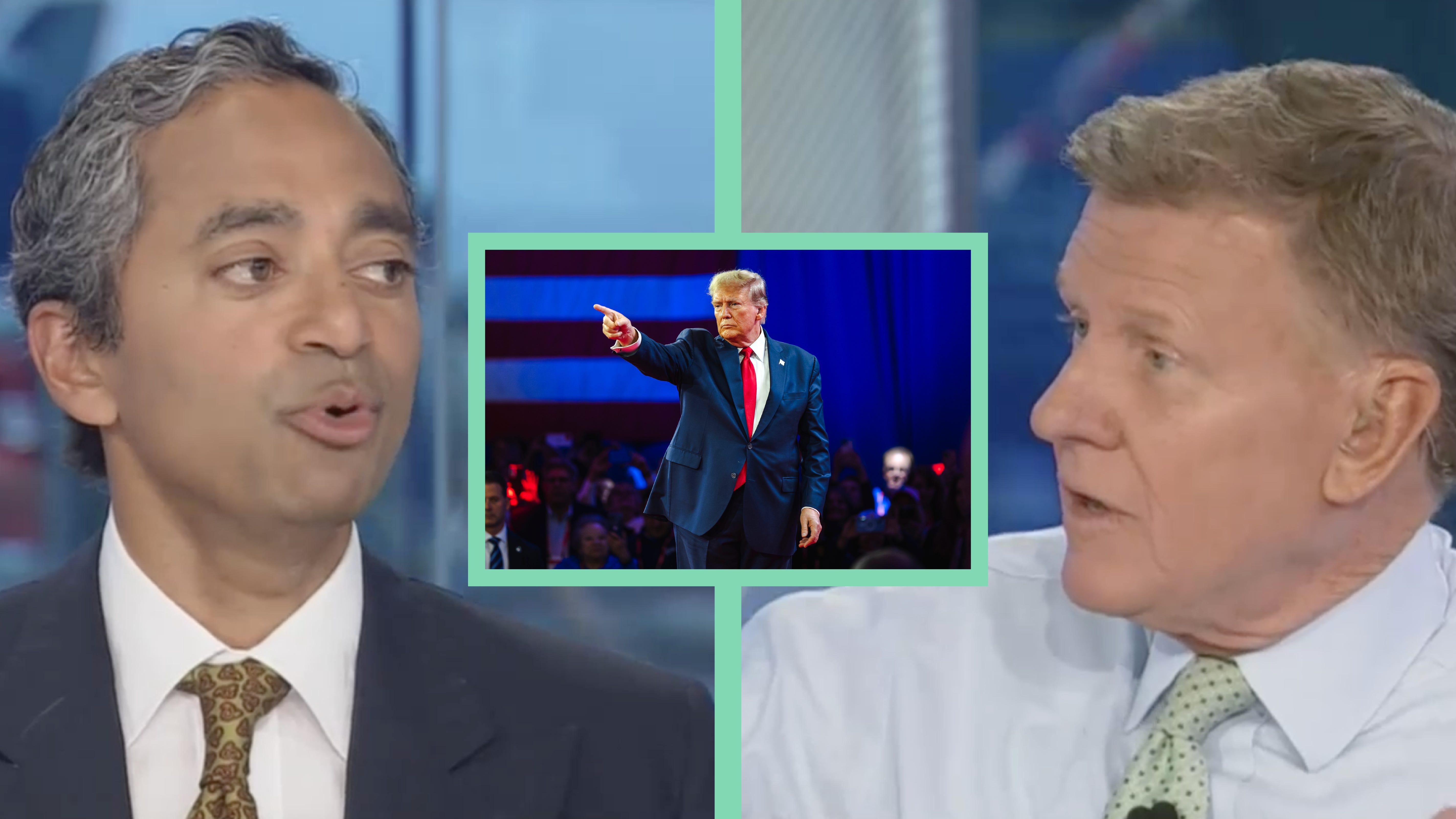
This May Be One of the Most Important Moments Ever Broadcast on CNBC
Billionaire Chamath Palihapitiya breaks from the Silicon Valley echo chamber and makes a stunning admission about President Trump.
Every once in a while, someone who spent years buying into the media’s narrative about President Trump publicly admits they got it wrong.
That’s exactly what happened on CNBC this morning.
Billionaire investor Chamath Palihapitiya conceded that he was one of the many influential voices who bought into the media’s narrative about Donald Trump.
Now, after revisiting the original source material and getting to know Trump personally, he’s publicly admitting he was wrong.
But there was more to it than just an admission of error.
Across one conversation, Palihapitiya not only praised Trump’s presidency, but argued that millions of Americans were fundamentally misled about the man himself.
Palihapitiya said his personal turning point was simply going back and watching the original footage that the media had spent years talking about.
According to him, that’s when everything unraveled.
The conversation started with CNBC’s Joe Kernen bringing up an old debate the two had.
Kernen reminded Chamath that he had recently admitted Kernen was right about climate change, then decided to ask one more question.
KERNEN: “You said I was 100% right on climate change.”
PALIHAPITIYA: “You were 100% right on climate change.”
KERNEN: “What about Trump?”
Chamath shook his head in agreement.
PALIHAPITIYA: “You’re 100% right on Trump. He’s fantastic!”
KERNEN: “Great person?”
PALIHAPITIYA: “Unbelievable person! Very smart on top of it. Open minded. Debates with you.”
KERNEN: “Great president?”
PALIHAPITIYA: “Great president, so far.”
Kernen had clearly been waiting for that moment.
But the biggest moment came when Palihapitiya explained how his opinion on Trump changed.
That admission immediately changed the direction of the conversation.
He told CNBC that he had fallen into the same trap as millions of other Americans who formed their opinions based on headlines, clips, and commentary instead of going back and examining the original statements themselves.
According to Palihapitiya, once he actually watched the source material, he realized the picture he had been given was completely different.
PALIHAPITIYA: “The reality is that most of us were lied to by the media about President Trump.”
“And if you just go back to the source material, you should take away two things.”
“One, he didn’t say half the things he said, and two, why did these other people just fabricate what they wanted to say so that they could essentially assassinate his character?”
“I think that that second thing is completely unacceptable in America, and there’s still been no repercussions, really.”
Palihapitiya explained that one of the biggest turning points for him came when he revisited the controversy surrounding Trump’s comments after Charlottesville.
He said he realized that the version of events he had accepted did not line up with what Trump had actually said.
That led him to reconsider his entire view of the president.
PALIHAPITIYA: “I took the time to learn about it. I admitted where…you know, the way that I met him was, I admitted on the pod, which, you know, has millions of viewers.”
“And I said, I got it totally wrong because I went and I watched Charlottesville.”
The part that surprised everyone on the panel was what came next.
Palihapitiya said that after publicly admitting he had gotten the Charlottesville issue wrong, he received a phone call from President Trump himself.
PALIHAPITIYA: “And, you know, the first person to call me? President Trump.”
“And I got to know him and I put the phone down, I called my wife, and I said, we got it TOTALLY, totally wrong. We were lied to.”
“And then I got to know him and he is fantastic!”
It was a remarkable on-air admission from someone who had previously viewed Trump negatively.
Palihapitiya’s argument was that his experience was not unique — millions of Americans had formed their opinions from the same sources and may have never gone back to examine the original material themselves.
Palihapitiya continued explaining that his shift in opinion was not based on politics alone.
He argued that when evaluating any political figure, people should be willing to separate the individual issues from the emotional reaction surrounding the person.
That same approach shaped his views on Trump’s foreign policy, particularly Iran.
When CNBC’s Andrew Ross Sorkin asked where he stood on Trump’s handling of Iran, Palihapitiya said one thing above everything else changed his perspective — Trump’s insistence that Iran could never be allowed to obtain a nuclear weapon.
PALIHAPITIYA: “On the broad based things that he did, I think that he has been way more right than wrong.”
SORKIN: “Where do you land on the war in Iran?”
PALIHAPITIYA: “The most important thing that got me to see his point of view is he was completely binary on there can not be nuclear war.”
Palihapitiya said preventing a nuclear-armed Iran outweighed everything else.
He even pointed to Warren Buffett and Charlie Munger, arguing they had long described nuclear war as humanity’s greatest existential risk.
PALIHAPITIYA: “And what’s so interesting about, you know, like Warren Buffett in that last segment, who, by the way, should give all of his money if he wants to give it away to Trump Accounts…”
“If you ask Buffett, Buffett would also say the same thing. He and Munger used to say in their letters, there’s only one risk for humanity: nuclear war.”
“And so when you have a madman country that is attempting to destabilize the ability for all of us just to live our lives, I think he was pulled into a situation he didn’t want to be in because he believed strongly in no nuclear weapons.”
“I support that because I think everybody is forgetting the chaos that that kind of thing can create in the world.”
Later in the conversation, Palihapitiya turned his attention toward what he called “Trump Derangement Syndrome” and argued that political hatred toward Trump has pushed some people into making irrational decisions.
Palihapitiya was taking a sledgehammer to an ideology that permeates mainstream networks in real time.
It was incredible to watch.
He pointed to criticism over Trump-associated programs and argued that refusing to participate in something beneficial simply because it has Trump’s name attached to it makes no sense.
PALIHAPITIYA: “Now, can I just say something else?”
“You’re allowed to disagree with the guy.”
“You’re allowed to maybe dislike the guy.”
“But as an adult living human being that’s responsible for taking care of your family, you have to get past the TDS.”
“See where he’s right, see where he’s wrong.”
“But the TDS thing that’s stopping people from making a savings account for their children, that can give them free money…it is INSANE!”
Taken together, it was one of the most striking conversations CNBC has aired in a long time.
For years, Palihapitiya was part of the same world that accepted the media’s portrayal of Trump at face value.
Now he’s openly saying he believes that portrayal was false, that he changed his mind after examining the evidence himself, and that far more Americans should be willing to do the same.


We call it TDS, Trump Derangement Syndrome but a more accurate name would be Mass Media Derangement Syndrome b/c its the media causing it and in this case Trump was simply their target. They could have done the same to Ron Paul if he had ever gotten to the final race and allowed a honest chance at wining . Had Ron Paul been president the media would have done the same "loosing its mind, go scorched earth" approach b/c the media is owned by corrupt wealthy individuals who are hell bent on not allowing any national leaders into office that they do not control.
CNBC Sqawk Box had him on for more than 45 minutes
this morning The segment was amazing